Why Shopify Stores Lose 20–40% of Discovery Opportunities Without Realizing
Why Shopify Stores Lose 20–40% of Discovery Opportunities Without Realizing
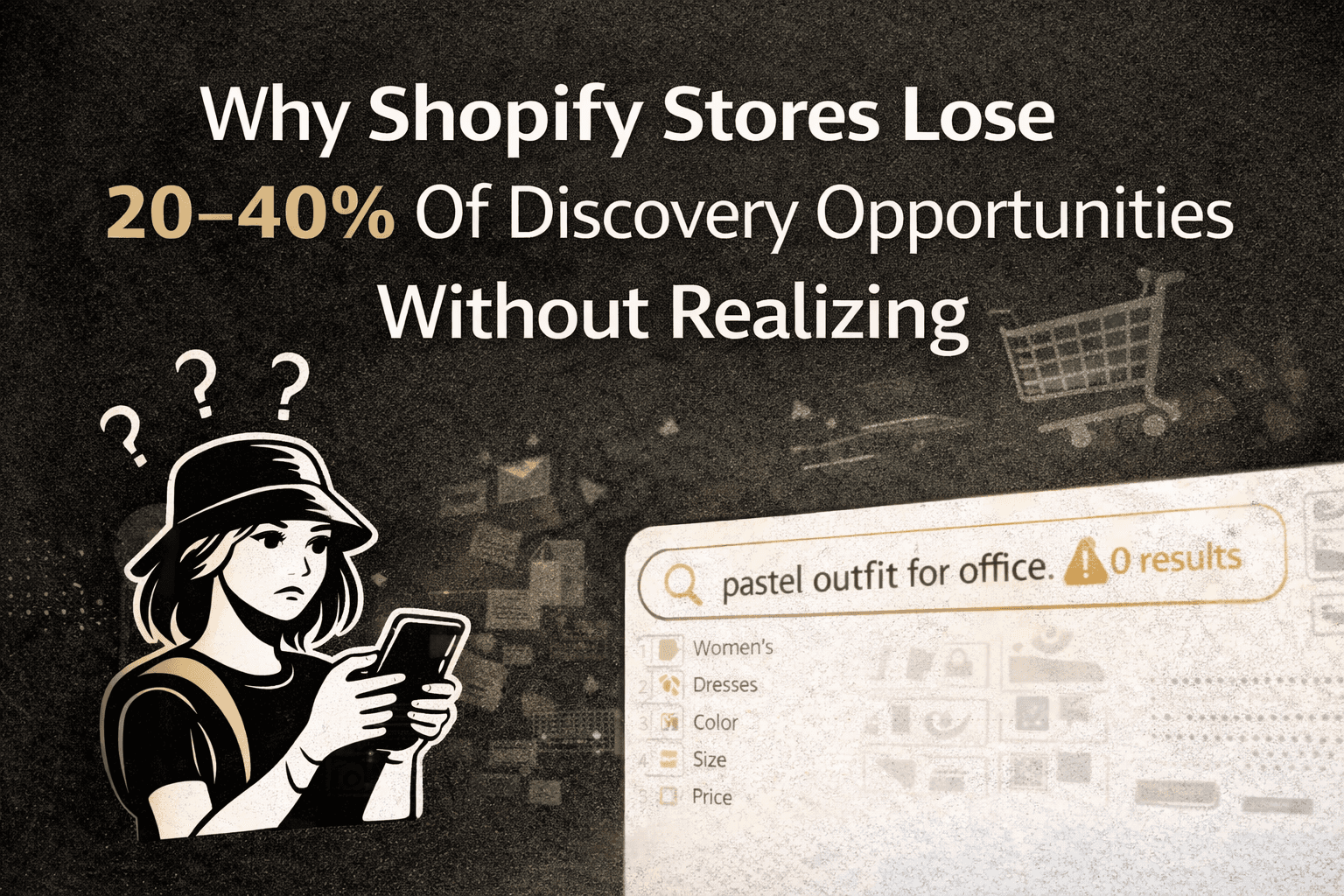
Most Shopify stores don’t lose revenue because of pricing or traffic, they lose it at discovery. Shoppers increasingly search using occasions, moods, and constraints, but traditional search systems don’t understand this kind of intent. This breakdown explains why 20–40% of discovery opportunities quietly disappear and how teams can fix it without changing themes or plugins.
Most Shopify stores don’t lose revenue because of pricing or traffic, they lose it at discovery. Shoppers increasingly search using occasions, moods, and constraints, but traditional search systems don’t understand this kind of intent. This breakdown explains why 20–40% of discovery opportunities quietly disappear and how teams can fix it without changing themes or plugins.

Lokesh Sharma
Dec 18, 2025
Dec 18, 2025
Introduction
Most Shopify stores don’t lose revenue because of pricing, traffic, or even product quality.
They lose it much earlier at the moment of discovery.
Over the past few months, while studying conversational shopping behavior across fashion D2C stores, one pattern showed up repeatedly:
Shoppers know what they want but don’t know how to describe it in “search language.”
When that translation fails, users bounce even when the store already has the right products.
This article breaks down why that happens, how big the impact really is, and why most teams never notice it.
The Discovery Gap No One Is Measuring
Ask a typical fashion shopper what they’re looking for, and you’ll rarely hear a clean keyword.
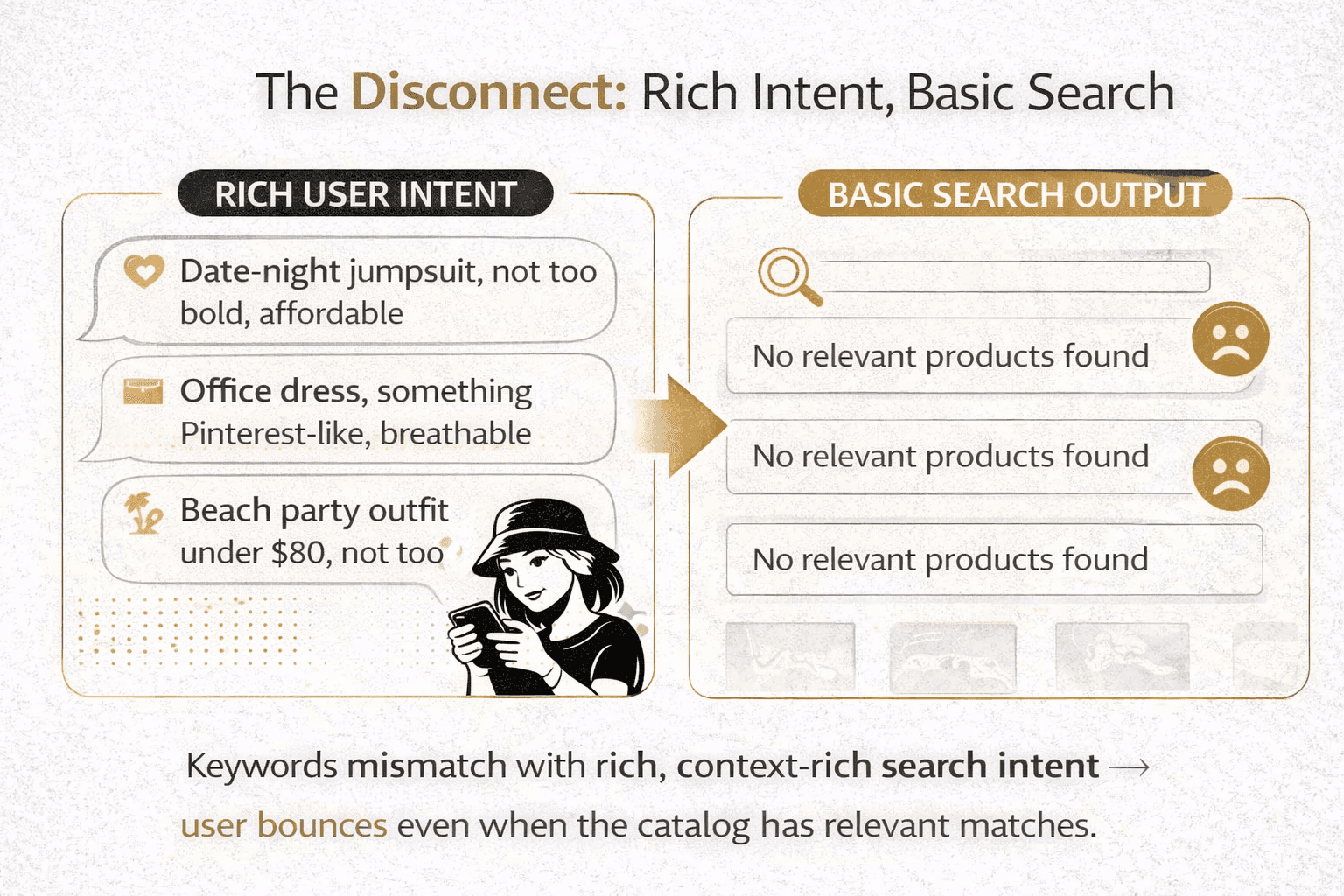
Instead, you’ll hear intent expressed as:
Occasions: “office Fridays”, “date night outfit”, “beach vacation.”
Moods/aesthetics: “minimal”, “clean”, “something bold.”
Constraints: “under $80”, “not too bright”, “comfortable but polished.”
These are perfectly valid buying signals.
The problem is that most Shopify search setups are not designed to understand them.
They expect:
product names
exact attributes
predefined filters
So when a user types:
“pastel outfit for office, not too formal”
The system often treats it as noise, not intent.
Why This Leads to Silent Revenue Loss
Here’s what typically happens behind the scenes:
A high-intent shopper types a descriptive query
Search returns weak or irrelevant results
The user assumes the store doesn’t have what they want
They leave without ever reaching a product page
From the merchant’s dashboard, this looks like:
normal bounce
casual browsing
“low-intent traffic”
In reality, intent existed; discovery failed.
Industry research supports this:
Baymard Institute shows that over 30% of e-commerce site searches return irrelevant or zero results, directly contributing to abandonment
https://baymard.com/research/ecommerce-search
What’s important here:
This loss rarely shows up as a clear metric.
No error logs.
No angry feedback.
Just quietly lost opportunity.
Fashion Makes This Problem Worse (and More Expensive)
Fashion discovery is inherently:
subjective
context-driven
emotionally framed
A user searching “black dress” could mean:
office wear
party outfit
wedding guest look
And a user searching:
“something minimal for date night, under $100”
is already deep into consideration — but traditional search can’t parse that depth.
Shopify itself acknowledges that search users are among the highest-intent visitors:
Visitors who use site search convert 2–3× higher than non-search users, when search works
https://www.shopify.com/in/blog/how-to-optimize-your-search-and-discovery-experience-on-shopify
Which means:
When search fails, you’re losing your best traffic first.
The Core Issue: Search Was Built for Keywords, Not Intent
Most commerce search systems still operate on a simple assumption:
Users will adapt their language to the system.
But consumer behavior has moved in the opposite direction.
Research from McKinsey highlights that younger shoppers prefer interactive, personalized, and conversational experiences over rigid interfaces:
https://www.mckinsey.com/industries/retail/our-insights/true-gen-generation-z-and-its-implications-for-companies
In practice, this means:
Users describe situations, not SKUs
They expect the system to interpret, not just match
They don’t want to “learn” how to search
When the system doesn’t meet them halfway, they leave.
Why Merchants Don’t Realize What They’re Losing
Most teams look at:
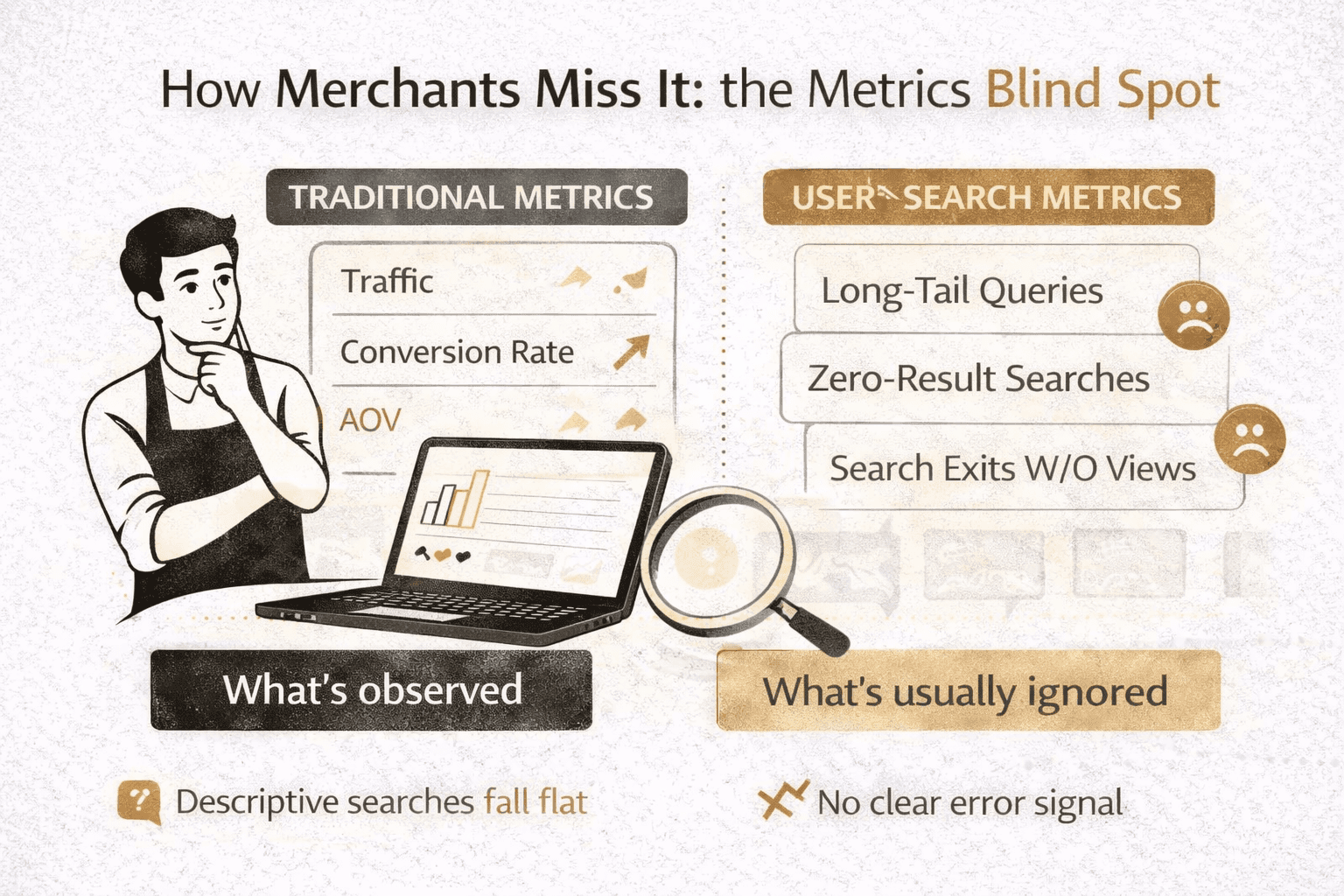
Traffic
Conversion rate
AOV
Top search terms
But very few look at:
Descriptive or long-tail search queries
Queries with zero or low-quality results
Search exits without product views
So the loss stays invisible.
In our reviews across fashion Shopify stores, this blind spot consistently translated to meaningful missed discovery, often in the 20–40% range for intent-rich searches.
Not because products were missing.
But because understanding was.
The Shift That’s Starting to Happen
Forward-looking teams are beginning to rethink discovery as:
An interpretation problem, not a tagging problem
A flow, not a single search box
A conversation, not a query
This doesn’t require:
Changing themes
Rebuilding the store
Adding dozens of plugins
It starts with:
Acknowledging how shoppers actually express intent
Measuring where that intent is being dropped
Designing discovery to resolve, not reject, ambiguity
A Practical Lens for Merchants & Agencies
If you’re working with Shopify stores today, a simple but powerful question to ask is:
“Where are shoppers telling us what they want but our system isn’t listening?”
That single lens often reveals:
Hidden demand
Misinterpreted behavior
And surprisingly quick conversion wins
Closing Note
We put this breakdown together because many partners told us this perspective helped them improve discovery and conversion without changing themes or plugins, simply by rethinking how intent flows through the store.
Introduction
Most Shopify stores don’t lose revenue because of pricing, traffic, or even product quality.
They lose it much earlier at the moment of discovery.
Over the past few months, while studying conversational shopping behavior across fashion D2C stores, one pattern showed up repeatedly:
Shoppers know what they want but don’t know how to describe it in “search language.”
When that translation fails, users bounce even when the store already has the right products.
This article breaks down why that happens, how big the impact really is, and why most teams never notice it.
The Discovery Gap No One Is Measuring
Ask a typical fashion shopper what they’re looking for, and you’ll rarely hear a clean keyword.
Instead, you’ll hear intent expressed as:
Occasions: “office Fridays”, “date night outfit”, “beach vacation.”
Moods/aesthetics: “minimal”, “clean”, “something bold.”
Constraints: “under $80”, “not too bright”, “comfortable but polished.”
These are perfectly valid buying signals.
The problem is that most Shopify search setups are not designed to understand them.
They expect:
product names
exact attributes
predefined filters
So when a user types:
“pastel outfit for office, not too formal”
The system often treats it as noise, not intent.
Why This Leads to Silent Revenue Loss
Here’s what typically happens behind the scenes:
A high-intent shopper types a descriptive query
Search returns weak or irrelevant results
The user assumes the store doesn’t have what they want
They leave without ever reaching a product page
From the merchant’s dashboard, this looks like:
normal bounce
casual browsing
“low-intent traffic”
In reality, intent existed; discovery failed.
Industry research supports this:
Baymard Institute shows that over 30% of e-commerce site searches return irrelevant or zero results, directly contributing to abandonment
https://baymard.com/research/ecommerce-search
What’s important here:
This loss rarely shows up as a clear metric.
No error logs.
No angry feedback.
Just quietly lost opportunity.
Fashion Makes This Problem Worse (and More Expensive)
Fashion discovery is inherently:
subjective
context-driven
emotionally framed
A user searching “black dress” could mean:
office wear
party outfit
wedding guest look
And a user searching:
“something minimal for date night, under $100”
is already deep into consideration — but traditional search can’t parse that depth.
Shopify itself acknowledges that search users are among the highest-intent visitors:
Visitors who use site search convert 2–3× higher than non-search users, when search works
https://www.shopify.com/in/blog/how-to-optimize-your-search-and-discovery-experience-on-shopify
Which means:
When search fails, you’re losing your best traffic first.
The Core Issue: Search Was Built for Keywords, Not Intent
Most commerce search systems still operate on a simple assumption:
Users will adapt their language to the system.
But consumer behavior has moved in the opposite direction.
Research from McKinsey highlights that younger shoppers prefer interactive, personalized, and conversational experiences over rigid interfaces:
https://www.mckinsey.com/industries/retail/our-insights/true-gen-generation-z-and-its-implications-for-companies
In practice, this means:
Users describe situations, not SKUs
They expect the system to interpret, not just match
They don’t want to “learn” how to search
When the system doesn’t meet them halfway, they leave.
Why Merchants Don’t Realize What They’re Losing
Most teams look at:
Traffic
Conversion rate
AOV
Top search terms
But very few look at:
Descriptive or long-tail search queries
Queries with zero or low-quality results
Search exits without product views
So the loss stays invisible.
In our reviews across fashion Shopify stores, this blind spot consistently translated to meaningful missed discovery, often in the 20–40% range for intent-rich searches.
Not because products were missing.
But because understanding was.
The Shift That’s Starting to Happen
Forward-looking teams are beginning to rethink discovery as:
An interpretation problem, not a tagging problem
A flow, not a single search box
A conversation, not a query
This doesn’t require:
Changing themes
Rebuilding the store
Adding dozens of plugins
It starts with:
Acknowledging how shoppers actually express intent
Measuring where that intent is being dropped
Designing discovery to resolve, not reject, ambiguity
A Practical Lens for Merchants & Agencies
If you’re working with Shopify stores today, a simple but powerful question to ask is:
“Where are shoppers telling us what they want but our system isn’t listening?”
That single lens often reveals:
Hidden demand
Misinterpreted behavior
And surprisingly quick conversion wins
Closing Note
We put this breakdown together because many partners told us this perspective helped them improve discovery and conversion without changing themes or plugins, simply by rethinking how intent flows through the store.
About Author
Lokesh Sharma cofounder, Eldor AI works at the intersection of search, machine learning, and agentic systems for commerce. An IIT Kanpur alumnus, he has spent years building large-scale AI and retrieval systems, focused on turning messy, real-world data into intuitive, high-impact user experiences.
Dec 17, 2025
/
Post by
Lokesh Sharma
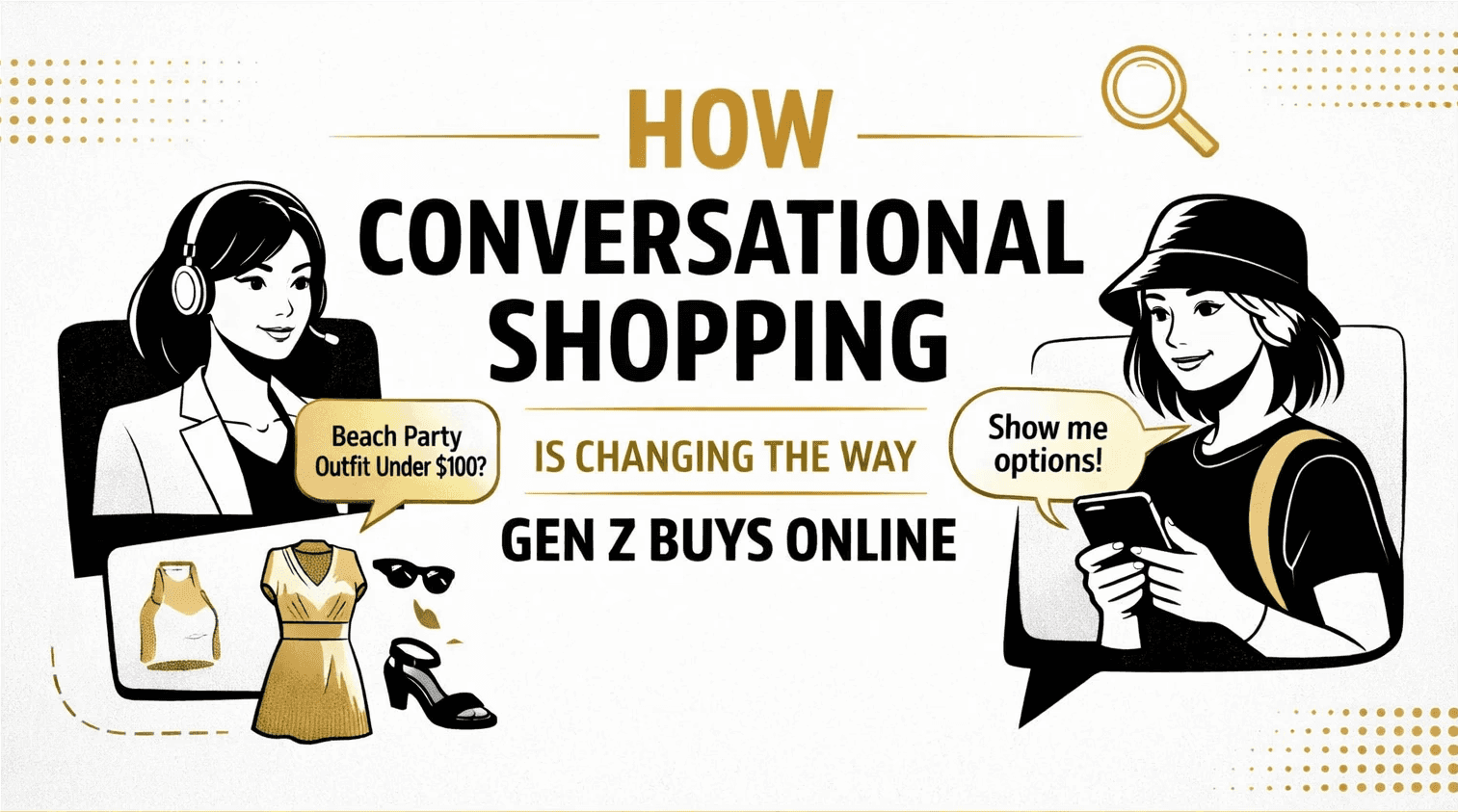
Gen Z doesn’t shop with keywords anymore. They describe intent, occasions, moods, budgets, and constraints in full sentences. This research unpacks why traditional search fails modern shoppers, how conversational shopping restores discovery and what fashion brands must do now to avoid losing high-intent customers silently.
Gen Z doesn’t shop with keywords anymore. They describe intent, occasions, moods, budgets, and constraints in full sentences. This research unpacks why traditional search fails modern shoppers, how conversational shopping restores discovery and what fashion brands must do now to avoid losing high-intent customers silently.
Dec 18, 2025
/
Post by
Lokesh Sharma
Most Shopify stores don’t lose revenue because of pricing or traffic, they lose it at discovery. Shoppers increasingly search using occasions, moods, and constraints, but traditional search systems don’t understand this kind of intent. This breakdown explains why 20–40% of discovery opportunities quietly disappear and how teams can fix it without changing themes or plugins.
Most Shopify stores don’t lose revenue because of pricing or traffic, they lose it at discovery. Shoppers increasingly search using occasions, moods, and constraints, but traditional search systems don’t understand this kind of intent. This breakdown explains why 20–40% of discovery opportunities quietly disappear and how teams can fix it without changing themes or plugins.