Conversational Commerce: What It Is, Why It Matters Now and Where It’s Going
Conversational Commerce: What It Is, Why It Matters Now and Where It’s Going
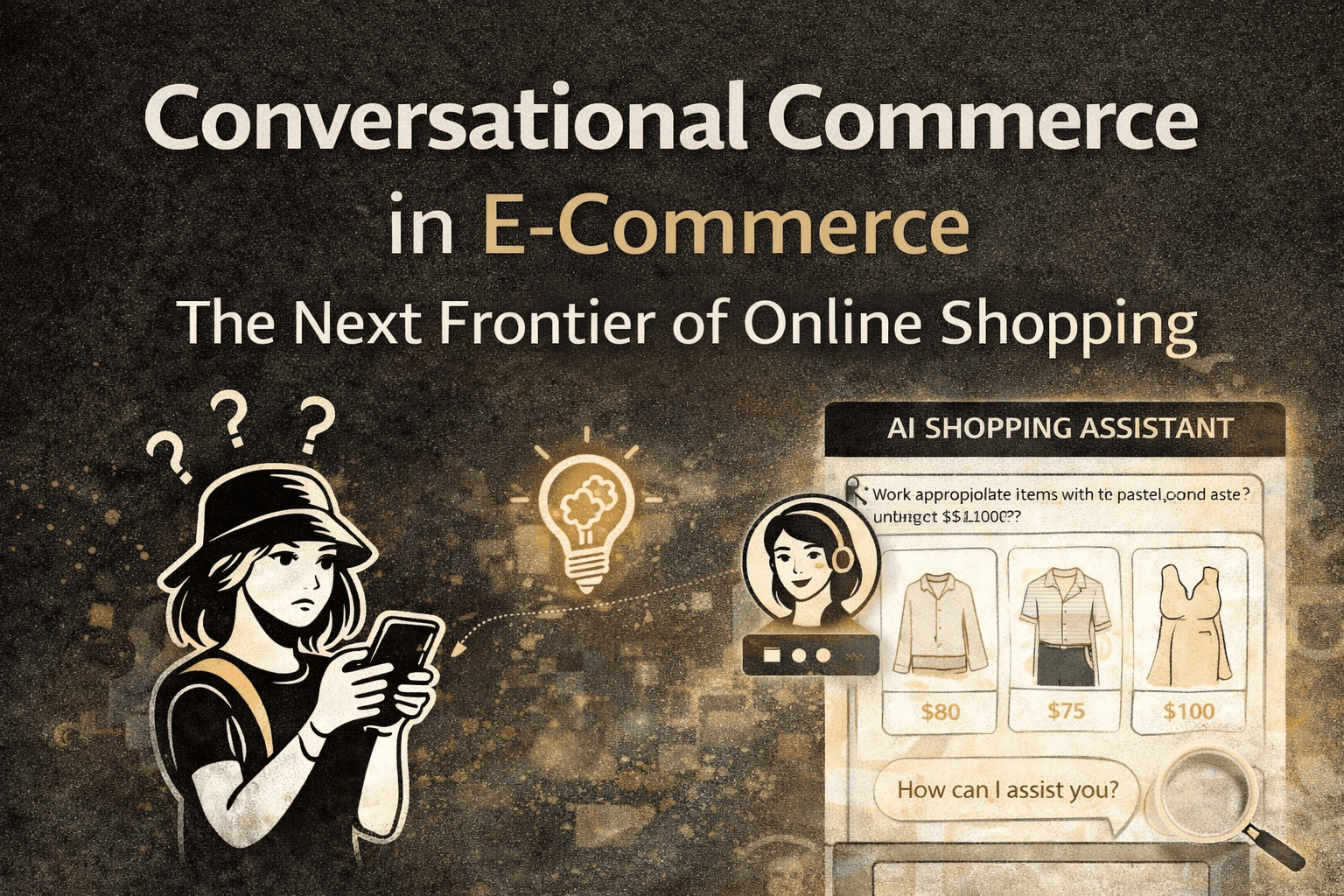
Traditional search matches keywords. LLM-based search finds semantically similar products. Conversational commerce goes a step further. It understands intent, shows relevant results and asks clarifying questions to guide shoppers toward better decisions.
Traditional search matches keywords. LLM-based search finds semantically similar products. Conversational commerce goes a step further. It understands intent, shows relevant results and asks clarifying questions to guide shoppers toward better decisions.

Lokesh Sharma
Dec 19, 2025
Dec 19, 2025
E-commerce has spent years optimizing pages, filters, and performance.
But shoppers haven’t changed how they think, only how they express it.
Today, users don’t search with keywords.
They describe intent.
They say:
“Office Fridays, but not boring.”
“Date-night outfit, minimal, not too bold”
“Pastel but not too bright, under $80.”
And most stores simply don’t understand that language.
This gap, between how shoppers think and how stores expect them to search, is why conversational commerce is emerging as one of the most important shifts in e-commerce.
This article explains:
What conversational commerce really is (and isn’t)
Why discovery is quietly breaking today
How it mimics the best in-store salespeople
And how this leads to a new model we call agentic commerce
1. What Conversational Commerce Actually Means
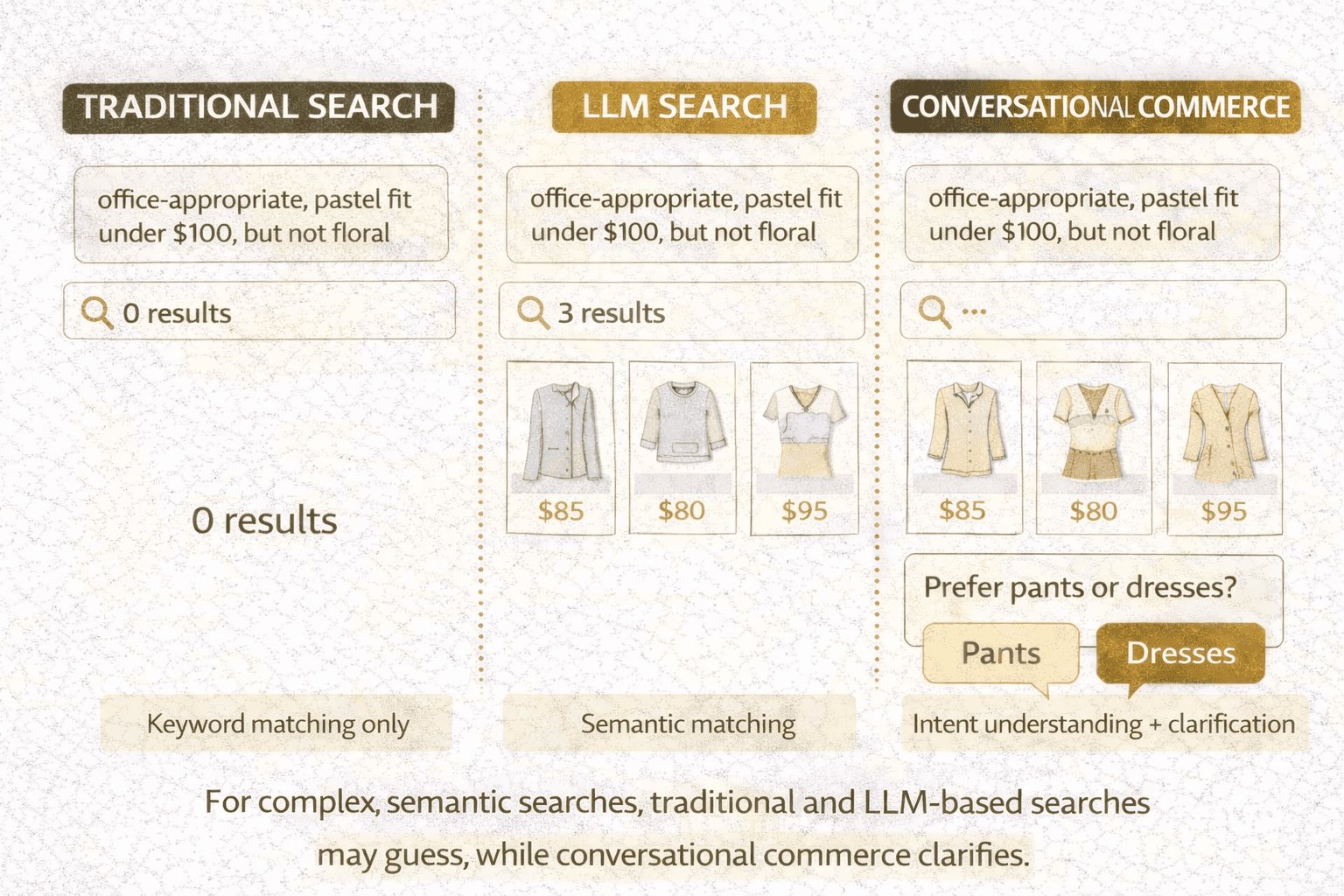
Conversational commerce is not a chatbot.
It is shopping through dialogue, where the system can:
Understand natural language intent
Ask clarifying questions when needed
Reason across constraints (budget, style, occasion)
Guide a user toward a confident purchase decision
Instead of:
search → filters → endless scrolling → exit
It becomes:
intent → clarification → guidance → decision
This shift matters because shopping is not a lookup problem.
It’s a decision-making problem.
2. Why Discovery Is Quietly Breaking in E-commerce
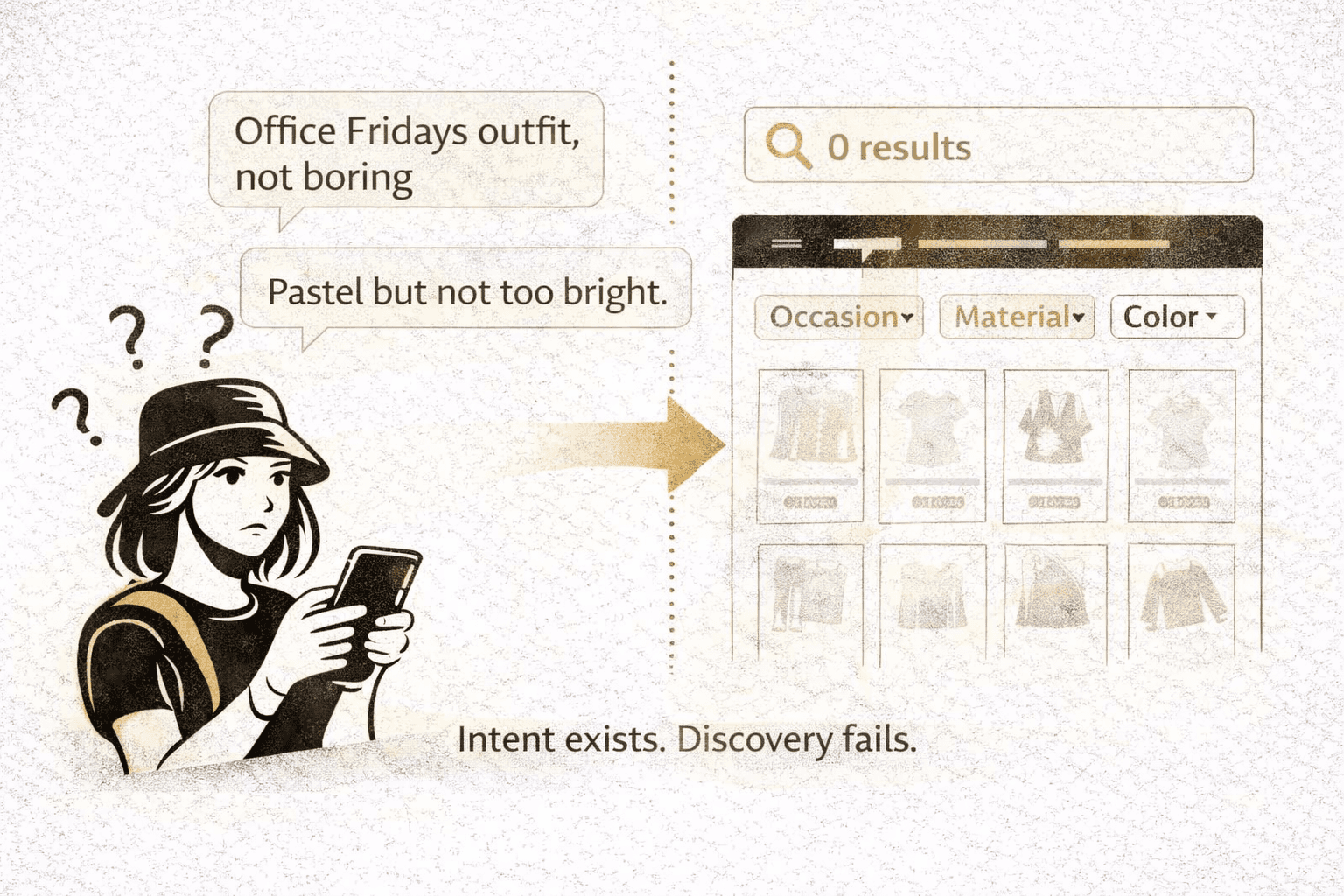
Most Shopify stores don’t lose revenue because of pricing or traffic.
They lose it at discovery.
What we consistently see across fashion stores:
Users browse multiple pages but “can’t find anything.”
Support tickets are essentially failed searches
Filters only help when users already know exactly what they want
When discovery fails, users don’t complain.
They bounce.
Baymard Institute’s long-running research shows that a large share of e-commerce sites struggle with search relevance, handling “no results,” and recovery paths, all of which directly cause abandonment.
https://baymard.com/research/ecommerce-search
Shopify itself highlights how important search users are:
Visitors who use site search typically convert 2–3× higher than non-search users, when search works
https://www.shopify.com/in/blog/how-to-optimize-your-search-and-discovery-experience-on-shopify
The implication is uncomfortable but clear:
When search fails, you lose your highest-intent shoppers first.
3. Why This Is Happening Now
Three forces are converging.
1) Consumer behavior has shifted
Gen Z and younger millennials expect systems to be interactive, contextual and adaptive, not static catalogs.
McKinsey’s research on Gen Z highlights this preference for personalized, responsive digital experiences.
https://www.mckinsey.com/industries/retail/our-insights/true-gen-generation-z-and-its-implications-for-companies
2) Consumers explicitly want AI in shopping
Capgemini reports that 71% of consumers want generative AI integrated into shopping experiences, especially for guidance and personalization.
https://www.capgemini.com/news/press-releases/71-of-consumers-want-generative-ai-integrated-into-their-shopping-experiences/
3) Technology has finally caught up
LLMs + modern retrieval systems now make it possible to interpret messy, human intent like:
“Not too flashy.”
“Pinterest-like”
“Goa beach party vibe”
4. Conversational Commerce Is Like Your Best Salesperson
The simplest way I explain conversational commerce to merchants is this:
Conversational commerce is about replicating your best in-store salesperson, online, at scale.
Not an average salesperson.
Your best one.
The one who:
Understands shoppers even when they’re vague
Knows fashion trends and what’s working right now
Deeply understands your catalog’s strengths and limitations
Can guide someone from a generic need to a confident decision
Great salespeople don’t wait for precision.
They create it through conversation.
5. Generic → Specific, Specific → Smarter
A strong conversational system works in both directions.
When a user starts generic:
“Outfit for a beach vacation”
A good system:
Infers climate, comfort and occasion
Asks only what matters
Gradually helps the shopper discover what they want
When a user starts very specific:
“White linen shirt, slim fit, under $70”
A good system:
Checks the feasibility within the brand’s catalog
Resolves conflicting constraints
Suggests the closest possible match and explains why
This matters because most D2C brands have finite catalogs.
Conversational commerce doesn’t blindly say “no results.”
It negotiates intent, just like a human would.
6. Rebuilding the Lost Personal Touch
Offline retail worked because of people.
Great salespeople:
Greet you naturally
Read your comfort level
Adjust tone and pace
Build trust before pushing products
Conversational commerce is about bringing that personal touch back online, without scripts, popups, or hard-coded flows.
When done right, it feels like:
Guidance, not selling
Help, not pressure
Confidence, not confusion
7. Why This Is NOT “LLM-Based Product Search”
This distinction is critical.
Conversational commerce is not:
An LLM layered on top of a keyword search
“Type anything, we’ll show products.”
A prompt pretending to understand shopping
It is a system, not a prompt.
It requires:
Deep catalog understanding
Intent reasoning across multiple dimensions
Constraint resolution
Multi-step decision flows
Session memory
Brand-aware guidance
That’s why it’s harder to build
and why it’s far more impactful when done right.
8. What Merchants Should Measure (But Rarely Do)
Most teams track:
Traffic
Conversion rate
AOV
Very few tracks:
Long-tail descriptive searches
Zero- or low-result queries
Search exits without product views
Support tickets that are actually discovery failures
This is where silent revenue loss hides.
Baymard’s research consistently shows that poor handling of search failures and “no results” pages leads to abandonment.
https://baymard.com/research/ecommerce-search
9. The Practical Path Forward (No Rebuild Required)
You don’t need to replace Shopify or redesign your theme.
Start by:
Collecting real search + support intent
Clustering intent by occasion, mood, constraints
Fixing “no results” behavior with recovery paths
Adding conversational entry points where intent is high
Measuring uplift for search users specifically
10. Eldor AI’s Vision: From Conversational to Agentic Commerce
At Eldor AI, we believe conversational commerce is just the beginning.
The real shift is agentic commerce:
AI sales agents that guide shoppers
AI support agents that resolve issues instantly
AI merchandising agents that learn from intent
AI growth agents that personalize without manual rules
All powered by a shared knowledge layer:
catalog + customer intent + store context
This is not about adding another plugin.
It’s about changing how commerce actually runs.
Closing Thought
The brands that win in the next decade won’t be the ones with the biggest catalogs.
They’ll be the ones whose stores can:
understand shoppers
guide decisions
and rebuild trust at scale
Conversational commerce is how that starts.
E-commerce has spent years optimizing pages, filters, and performance.
But shoppers haven’t changed how they think, only how they express it.
Today, users don’t search with keywords.
They describe intent.
They say:
“Office Fridays, but not boring.”
“Date-night outfit, minimal, not too bold”
“Pastel but not too bright, under $80.”
And most stores simply don’t understand that language.
This gap, between how shoppers think and how stores expect them to search, is why conversational commerce is emerging as one of the most important shifts in e-commerce.
This article explains:
What conversational commerce really is (and isn’t)
Why discovery is quietly breaking today
How it mimics the best in-store salespeople
And how this leads to a new model we call agentic commerce
1. What Conversational Commerce Actually Means
Conversational commerce is not a chatbot.
It is shopping through dialogue, where the system can:
Understand natural language intent
Ask clarifying questions when needed
Reason across constraints (budget, style, occasion)
Guide a user toward a confident purchase decision
Instead of:
search → filters → endless scrolling → exit
It becomes:
intent → clarification → guidance → decision
This shift matters because shopping is not a lookup problem.
It’s a decision-making problem.
2. Why Discovery Is Quietly Breaking in E-commerce
Most Shopify stores don’t lose revenue because of pricing or traffic.
They lose it at discovery.
What we consistently see across fashion stores:
Users browse multiple pages but “can’t find anything.”
Support tickets are essentially failed searches
Filters only help when users already know exactly what they want
When discovery fails, users don’t complain.
They bounce.
Baymard Institute’s long-running research shows that a large share of e-commerce sites struggle with search relevance, handling “no results,” and recovery paths, all of which directly cause abandonment.
https://baymard.com/research/ecommerce-search
Shopify itself highlights how important search users are:
Visitors who use site search typically convert 2–3× higher than non-search users, when search works
https://www.shopify.com/in/blog/how-to-optimize-your-search-and-discovery-experience-on-shopify
The implication is uncomfortable but clear:
When search fails, you lose your highest-intent shoppers first.
3. Why This Is Happening Now
Three forces are converging.
1) Consumer behavior has shifted
Gen Z and younger millennials expect systems to be interactive, contextual and adaptive, not static catalogs.
McKinsey’s research on Gen Z highlights this preference for personalized, responsive digital experiences.
https://www.mckinsey.com/industries/retail/our-insights/true-gen-generation-z-and-its-implications-for-companies
2) Consumers explicitly want AI in shopping
Capgemini reports that 71% of consumers want generative AI integrated into shopping experiences, especially for guidance and personalization.
https://www.capgemini.com/news/press-releases/71-of-consumers-want-generative-ai-integrated-into-their-shopping-experiences/
3) Technology has finally caught up
LLMs + modern retrieval systems now make it possible to interpret messy, human intent like:
“Not too flashy.”
“Pinterest-like”
“Goa beach party vibe”
4. Conversational Commerce Is Like Your Best Salesperson
The simplest way I explain conversational commerce to merchants is this:
Conversational commerce is about replicating your best in-store salesperson, online, at scale.
Not an average salesperson.
Your best one.
The one who:
Understands shoppers even when they’re vague
Knows fashion trends and what’s working right now
Deeply understands your catalog’s strengths and limitations
Can guide someone from a generic need to a confident decision
Great salespeople don’t wait for precision.
They create it through conversation.
5. Generic → Specific, Specific → Smarter
A strong conversational system works in both directions.
When a user starts generic:
“Outfit for a beach vacation”
A good system:
Infers climate, comfort and occasion
Asks only what matters
Gradually helps the shopper discover what they want
When a user starts very specific:
“White linen shirt, slim fit, under $70”
A good system:
Checks the feasibility within the brand’s catalog
Resolves conflicting constraints
Suggests the closest possible match and explains why
This matters because most D2C brands have finite catalogs.
Conversational commerce doesn’t blindly say “no results.”
It negotiates intent, just like a human would.
6. Rebuilding the Lost Personal Touch
Offline retail worked because of people.
Great salespeople:
Greet you naturally
Read your comfort level
Adjust tone and pace
Build trust before pushing products
Conversational commerce is about bringing that personal touch back online, without scripts, popups, or hard-coded flows.
When done right, it feels like:
Guidance, not selling
Help, not pressure
Confidence, not confusion
7. Why This Is NOT “LLM-Based Product Search”
This distinction is critical.
Conversational commerce is not:
An LLM layered on top of a keyword search
“Type anything, we’ll show products.”
A prompt pretending to understand shopping
It is a system, not a prompt.
It requires:
Deep catalog understanding
Intent reasoning across multiple dimensions
Constraint resolution
Multi-step decision flows
Session memory
Brand-aware guidance
That’s why it’s harder to build
and why it’s far more impactful when done right.
8. What Merchants Should Measure (But Rarely Do)
Most teams track:
Traffic
Conversion rate
AOV
Very few tracks:
Long-tail descriptive searches
Zero- or low-result queries
Search exits without product views
Support tickets that are actually discovery failures
This is where silent revenue loss hides.
Baymard’s research consistently shows that poor handling of search failures and “no results” pages leads to abandonment.
https://baymard.com/research/ecommerce-search
9. The Practical Path Forward (No Rebuild Required)
You don’t need to replace Shopify or redesign your theme.
Start by:
Collecting real search + support intent
Clustering intent by occasion, mood, constraints
Fixing “no results” behavior with recovery paths
Adding conversational entry points where intent is high
Measuring uplift for search users specifically
10. Eldor AI’s Vision: From Conversational to Agentic Commerce
At Eldor AI, we believe conversational commerce is just the beginning.
The real shift is agentic commerce:
AI sales agents that guide shoppers
AI support agents that resolve issues instantly
AI merchandising agents that learn from intent
AI growth agents that personalize without manual rules
All powered by a shared knowledge layer:
catalog + customer intent + store context
This is not about adding another plugin.
It’s about changing how commerce actually runs.
Closing Thought
The brands that win in the next decade won’t be the ones with the biggest catalogs.
They’ll be the ones whose stores can:
understand shoppers
guide decisions
and rebuild trust at scale
Conversational commerce is how that starts.
About Author
Lokesh Sharma cofounder, Eldor AI works at the intersection of search, machine learning, and agentic systems for commerce. An IIT Kanpur alumnus, he has spent years building large-scale AI and retrieval systems, focused on turning messy, real-world data into intuitive, high-impact user experiences.
Dec 17, 2025
/
Post by
Lokesh Sharma
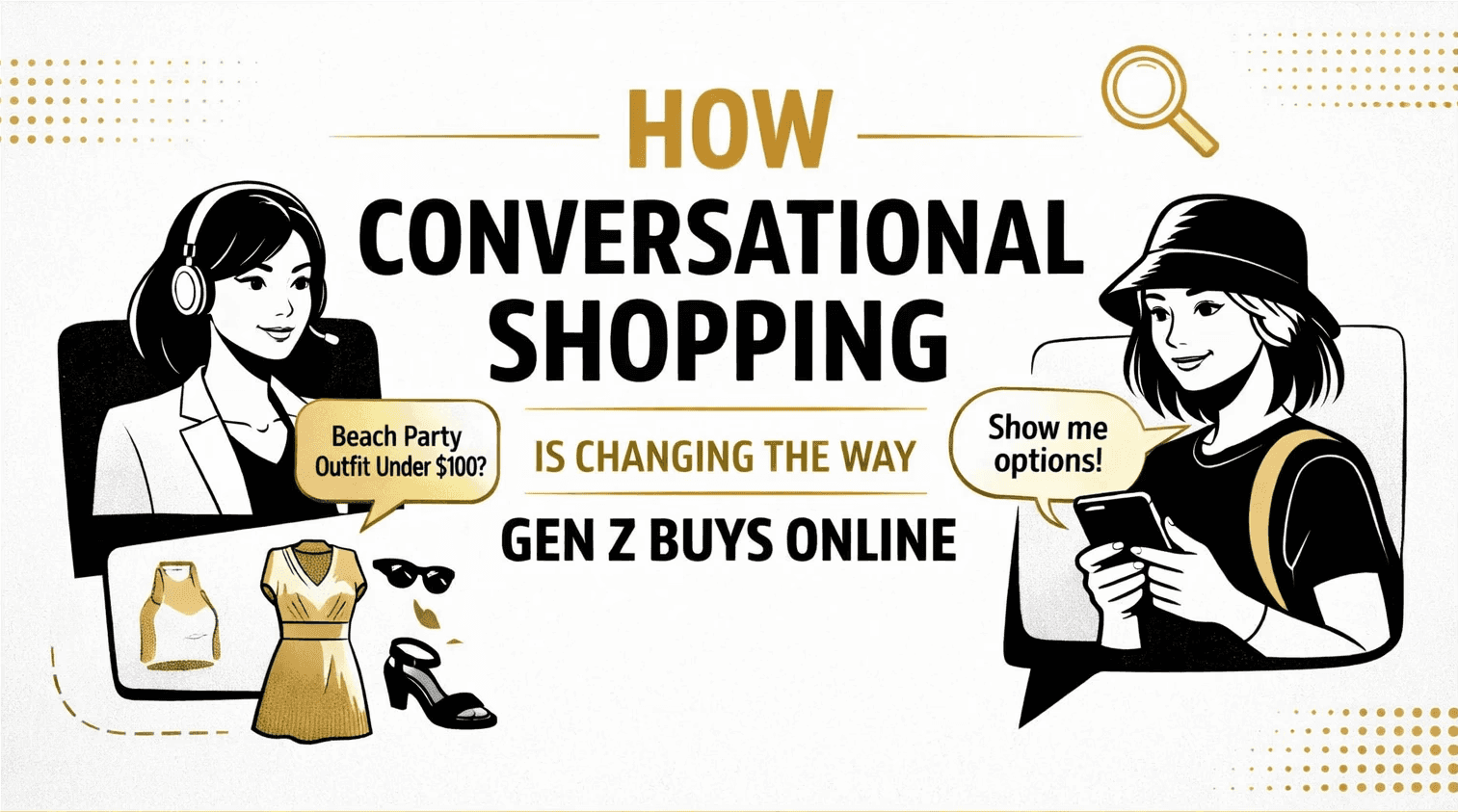
Gen Z doesn’t shop with keywords anymore. They describe intent, occasions, moods, budgets, and constraints in full sentences. This research unpacks why traditional search fails modern shoppers, how conversational shopping restores discovery and what fashion brands must do now to avoid losing high-intent customers silently.
Gen Z doesn’t shop with keywords anymore. They describe intent, occasions, moods, budgets, and constraints in full sentences. This research unpacks why traditional search fails modern shoppers, how conversational shopping restores discovery and what fashion brands must do now to avoid losing high-intent customers silently.
Dec 18, 2025
/
Post by
Lokesh Sharma
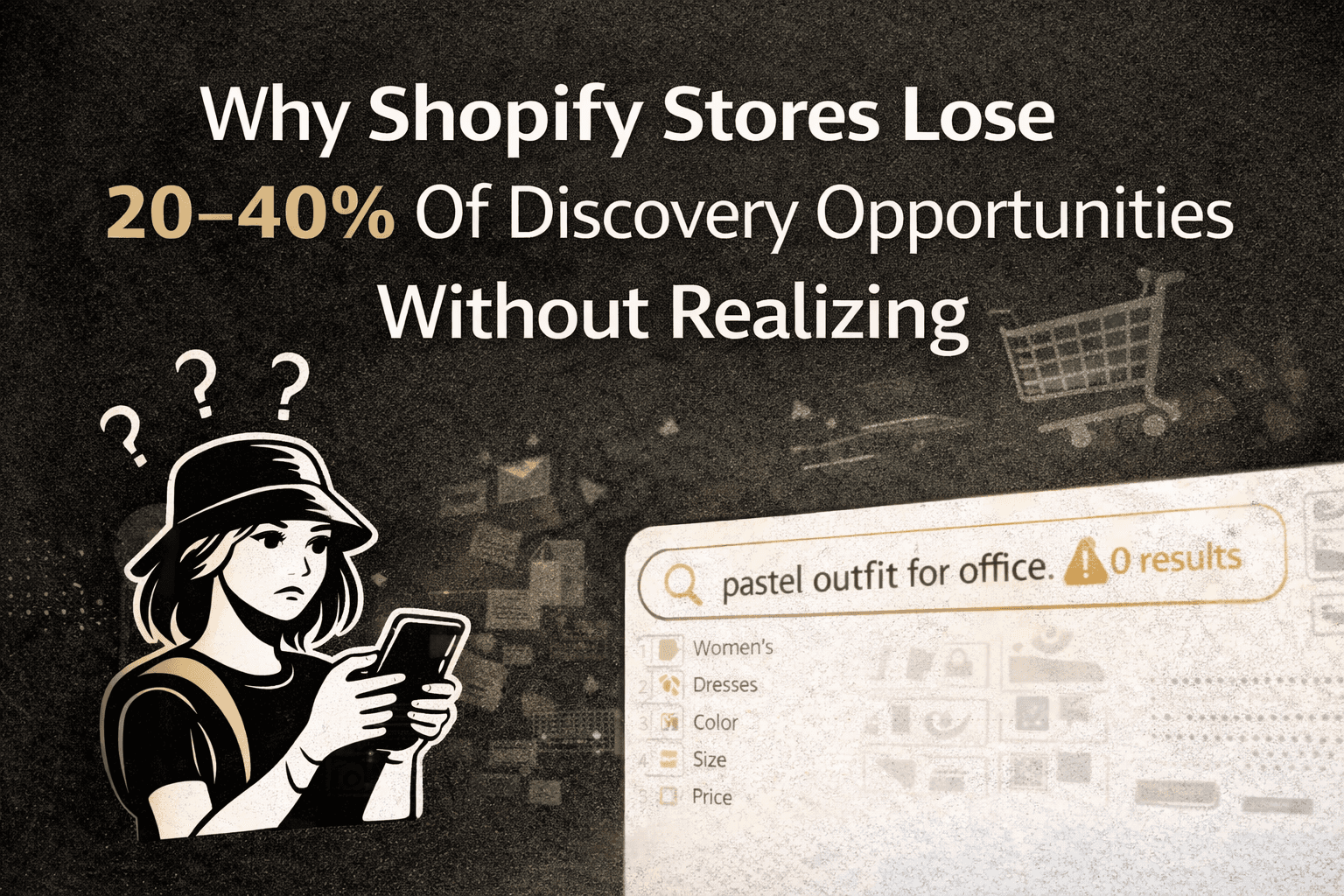
Most Shopify stores don’t lose revenue because of pricing or traffic, they lose it at discovery. Shoppers increasingly search using occasions, moods, and constraints, but traditional search systems don’t understand this kind of intent. This breakdown explains why 20–40% of discovery opportunities quietly disappear and how teams can fix it without changing themes or plugins.
Most Shopify stores don’t lose revenue because of pricing or traffic, they lose it at discovery. Shoppers increasingly search using occasions, moods, and constraints, but traditional search systems don’t understand this kind of intent. This breakdown explains why 20–40% of discovery opportunities quietly disappear and how teams can fix it without changing themes or plugins.